Thursday, February 07, 2008

ROCKIN' Dept. of Corrections & Additions_BOB DYLAN's 1966 "Judas" World Tour

(above) Dylan in transit on the UK tour, 1966, photo by Barry Feinstein
(I apologize for the poor quality download)
(above and two following) from "Like a Rolling Stone" video clip,
from footage shot in 1966, the electrified second set


(above) Robbie Robertson, lead guitarist and leader of the Hawks
(above) The Hawks onstage, on the UK tour
(above) finally, the official CD, still titled "Royal Albert Hall" concert in quotes,
although obviously now clearly showcasing the 5-17-66 Manchester event
(above and three below) from the Scorpio 8-CD bootleg set

(above and below) these photos may be those
of photographer Barry Feinstein. Certainly
the one with Dylan and the children is for sure.


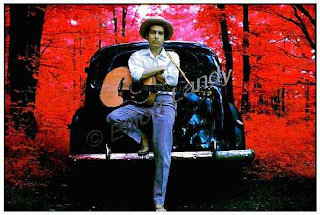
(above) following the harrowing 1965 and 1966 US and world tours,
Dylan returned home to Woodstock, NY, where he would
subsequently suffer a motorcycle accident. This photo was taken
years later, also in Woodstock, by Elliot Landy
-
Dylanologist I'm not, but I do have to correct my previous blog. The infamous Manchester, England concert on the 1966 so-called "Judas" world tour took place one week after Dylan boarded the Aust Ferry, bound for a concert in Cardiff, Wales. So the correct date for the show where "Judas!" was yelled at Dylan was May 17, 1966.
-
The world leg of the tour began in Australia on April 13, then went to Sweden and Denmark, then twelve concerts in Ireland, Wales, England, and Scotland, then to Paris, finally culminating in back-to-back shows at the Royal Albert Hall in London.
-
The Manchester concert was bootlegged for many years--under a number of different names beginning around 1970-71--before it was (at long last) officially released as the "quote" "Royal Albert Hall Concert" as the 2-CD "Bootleg Series Set #4" in 1998. Though now recognized as the Manchester Free Trade Hall concert of May 17, fans had erroneously called it the "Royal Albert Hall" for decades, hence the wink and nod from the record company.
-
The official CD was a commercial and critical success, reaching #18 on the UK album charts. One song from the actual Royal Albert Hall concerts (May 26), "Visions of Johanna," had been previously released on Dylan's boxed-set retrospective BIOGRAPH in 1985.
-
Filmed excerpts from the 1966 UK performances are the backbone, in many respects, of Martin Scorsese's 2005 television documentary NO DIRECTION HOME--including the "Judas" incident used to close the work. Some footage in Scorsese's film had been held back by Dylan for years. Dylan apparently had assumed control over footage shot by D.A. Pennebaker for a second live documentary, to be called EAT THE DOCUMENT, but an initially edited version was termed incomprehensible when presented for network airing. Filmmaker Howard Alk (seen next to the car in Barry Feinstein's ferry shot) was a key player in the second year's filming (the first, from 1965, resulted in Pennebaker's DON'T LOOK BACK). THE BOB DYLAN SCRAPBOOK 1956-1966, co-authored by Robert Santelli, is a companion to the Scorsese film and well worth seeking out for the wealth of memorabilia reproductions tipped-in.
-
Another filmmaker was drummer Mickey Jones, whose 8-mm "amateur footage" was later assembled into a DVD entitled 1966 WORLD TOUR (THE HOME MOVIES). The "Judas" moment is shown here as well.
-
Feinstein has himself released a DVD entitled WORLD CONCERTS 1966 AND 1974 (fyi, 1974 was when Dylan once again toured with The Band; they were known as The Hawks in 1966). A 160-pg book of Feinstein's photos from the '66 tour, entitled REAL MOMENTS, is scheduled for release this year. (fyi, Feinstein had taken the iconic photo that appears as the cover of Dylan's 1963 LP, THE TIMES THEY ARE A CHANGIN', and so was invited to come along in '66 as official photographer).
-
For many years, Dylan fans had to survive with just bootlegs. Ironically, one of the most interesting appeared as an 8-CD set in 2000, entitled GENUINE LIVE '66. It apparently contains "crystal clear" line recordings from many of the dates previously unavailable or available only as poor quality, surrepticious audience recordings.
-
A great UK YouTube clip of Dylan and the Hawks performing "Like a Rolling Stone" (possibly from the Manchester concert) can be found at: http://uk.youtube.com/watch?v=xO0gSJGJ7Fs. Note that the clip has received over 2 million hits.
-
In researching aspects of the "Judas" tour as relating to the Aust Ferry shot, I was egged on by ROCKIN's editor Dennis Pernu. So the bit that follows may simply add to the myth, or may clear things up. It involves the answer to the question, who (Dylan?) (or, someone else on stage?) told the band to play "Like a Rolling Stone" full-tilt, as in "play it fuckin' LOUD," in response to the call of "Judas" from the audience. This is taken from a piece in the Sentinel newspaper in England (Feb. 2, 2008; slightly edited for clarity here):
-
"Much has been written about the Bob Dylan concert at Manchester's Free Trade Hall on May 17, 1966. It has become one of popular music's defining moments when Dylan turned electric.
-
"As catcalls were mewling around the home of the Halle Orchestra, one voice was heard above the rest crying "Judas!" Thirty-odd years later, the owner of that voice was identified as a Keele University student, Keith Butler.
-
"But there was another voice that was also caught on the bootleg recordings. Newcastle musician and Dylan enthusiast Scott Ralph has studied the tapes and believes the second voice, for many years attributed to Dylan himself calling to his band--"Play (expletive) LOUD" was in fact that of local singer/songwriter Kevin Sauntry.
-
"'Dylan shouts to the Judas man, 'You're a liar!' says Ralph. "Then you hear the shout with the swearword in it. But that voice isn't Dylan's. It clearly has a Manchester accent and I'm sure it belongs to Kevin."
-
"'Yes, I was at the concert that night in 1966,' the now 63-year old Sauntry confirms. 'But you need to know the build-up. I was a '60s Wythenshawe lad who didn't give tuppence for authority, but I was socially aware. Dylan was at the Free Trade Hall and the establishment hadn't yet got the mood of the big social changes which were going on.
-
"'A group of us bought tickets for very good seats a month in advance. That night, we waited at the head of the queue controlled by some hired British Legion stewards.
-
"'Some people dressed posh, some trendy, and some as best they could. The man taking the tickets resembled Softy Walter out of the Beano. He took our tickets then told us to wait. When he returned, he was smiling. 'Ah yes, I've sorted it out now,' he preened. 'Unfortunately we've had to give your seats to some important people, but don't worry, go to the ticket desk and you'll be fully reimbursed.
-
"'Now he couldn't have said anything worse than tell me he'd just tortured my dog to death. We stood there blankly. Then, condescendingly he said, 'Off you go.' You can perhaps imagine the colour of the language that followed.
-
"'At this point, the crowd behind us became aware of what was going on and started chanting 'Let them in!' A police sergeant arrived, who after some discussion, told "Softy Walter" that his best option to avoid a riot was to get us some seats. And that's how we got to sit on stage. "Softy" apparently was used to docile Halle Orchestra audiences. He thought we'd just shove off miffed when he offered us seats at the back of the stage. But he'd gone from being our worst enemy to being our best friend.
-
"Dylan came out and thought Sauntry's group were stage hands. 'He was doing acoustic solo songs in the first set and it was great,' Sauntry continued. 'The second half, we were a bit taken aback when a band came on with him. The band members actually shook our hands, possibly because management may have told them we were eight lunatics specially placed on stage.
-
"'After the first electric song I remember the applause wasn't so spontaneous. During the next song, the audience began to mumble and shift around restlessly. Then came the infamous shout, 'Judas!,' and some of the crowd clearly subscribed to that. Dylan shouted back, 'I don't believe you--you're a liar!' And all of us on stage went with Bob--'Yeah!, Yeah!'
-
Into the third song people started to throw rolled-up programmes onto the stage, so we just chucked them back. Then all mayhem ensued. Some people in the audience were standing up, screaming and shouting, some seemed to be forcing their way to the stage, and we were nearby in the midst of this chaos.
-
"'This is where the 'Play (expletive) LOUD' came in.
-
"I've been asked if that was me. All I can say is, I was shouting all sorts from the stage. I remember thinking, 'hey up, these Americans look a bit windy, maybe they better play louder.' But we were ready for anything. And after "Like a Rolling Stone," people in the audience actually started to leave. We just sat back and saw the rest of the concert out.
-
"'As Dylan was coming off stage, my friends and I congratulated him. He looked really shocked. 'That was worse than a riot in New York,' he said. I'm not sure to this day whether what he really meant was, 'with friends like you guys, who needs enemies?'
-
"So, was it Dylan who shouted to his band to play louder? Was it Kevin Sauntry? Or was it a member of the stage crew, as drummer Mickey Jones thinks? Scott Ralph remains convinced. 'There's no doubt, whoever it was had a heavy Manchester accent--and I know Kevin's voice as well as my own!'"
-
As the video clip shows (if indeed it is the Manchester performance of "Like a Rolling Stone"), that song ends the concert and Dylan is quickly escorted to a limo waiting outside, so that would contradict the song's placement in the Kevin Sauntry narrative. And, it's unclear where he had been given seats, as none of the camerawork panning over the full stage show "seats onstage" or even just offstage. And the few shots of the audience don't seem to indicate a full riot in the making. But the claim is plausible . . . sort of . . . maybe.
-
Of course, at other points on the tour, audiences were heard shouting "Turn it down!" Rather an odd response to electric rock as we know it today . . . "Yeah, turn it up!!" being quite the call of choice instead.

Wednesday, February 06, 2008

a fine ROCKIN' tale of a ferry, a treacherous river, two bridges, and Dylan in '66

(above) our inimitable subject, 1966, at Aust, England ferry terminal, May, 1966
The Severn Bridge is in the background.
(above) the previous year in the UK, the enigmatic star of

D.A. Pennebaker's DON'T LOOK BACK
(above) today, where Dylan awaited the Severn Princess, then
note the Severn Bridge in the background
(above) the Princess today, beached and awaiting TLC, in Beachley, Wales
(above) the Princess, upon its final return home, but likely before its final move
(above) The Severn Bridge, which did in the ferry, in 1966.
Look closely, and you can see the last ferry, about to dock.
(above) further out towards the river, the Aust - Beachley ferry slip today
(above and below) the Princess in 1982, in Ireland, creating a fish farm
using DeLorean Car body-part dies as anchors for the nets

(above) the Princess launched, 1959
(above) a member of the family of Severn River ferries,
either the King or the Queen, likely in the late 1940s
(above) the CD version of the photo . . . but without the bridge
(also, a digitized change to the license plate, as noted below)
(above) the mighty Severn River bridge (first of the two standing today)
opened in 1966 by Queen Elizabeth II
(above and below) the new Severn River bridge, with
its very necessary side wind baffles
The Martin Scorsese film NO DIRECTION HOME (first screened in England in 2005) about the life of Bob Dylan has a promotional shot of Dylan--one of rock's most iconic photos--standing in front of the Aust, England ferry terminal on May 11, 1966, just months before the historic ferry closed for good.
-
Dylan was on his way to a concert in Cardiff, South Wales, seventy miles away following a gig in Bristol which towards the beginning of the '66 UK tour. Here he is the following day, as he set off in a cold, drizzling rain for the next show, with the previous night's concertgoers boos maybe still ringing in his ears (if indeed he even cared to remember). So it's hardly surprising he looked mean and moody--clad in Carnaby Street black, hands in pockets, shoulders hunched against the elements, hiding behind dark glasses on an overcast day--as he waited for the ferry. Whether Dylan appreciated it at the time, in UK lore the ferry and the River Severn were long intertwined; the river itself having been known over centuries for its gale-force winds and dangerously choppy seas in the estuary, leading to the Bristol Channel, to the Celtic Sea, and to the Atlantic Ocean.
-
When Scorsese's people called, American photographer Barry Feinstein rediscovered his original proof sheet from that day in 1966 (he was the tour photog). This shot from that series was eventually voted as one of the five top rock photos of all time. "I think it was the British weather that made him look so gloomy," Feinstein recalled. "But everyone was a bit worn out from traveling, from the booing, and from the previous year of controversial developments that had led up to this tour."
-
The movie itself drew from hundreds of hours of unseen footage, rare recordings, and in-depth interviews. Feinstein, a celebrated portraitist, also was the still photographer for such classic movies as EASY RIDER and MONTEREY POP.
-
The car in the picture, a British-made Austin Princess, belonged to the Rolling Stones. The man leaning on it was Dylan's filmmaker of that year, Howard Alk. A previous film, DON'T LOOK BACK, was filmed in England by D.A. Pennebaker in 1965.
-
Dylan had good reason to look pissed off. Then 25, he was still at the beginning of what would be called the "Judas" tour. The previous night, May 10, at Colston Hall in Bristol, as the second half of the concert began with Dylan's band donning electric instruments, he was heartily berated by the audience (hardcore folkies who continued to see him as betraying the folk music movement). So on this tour's shows, Dylan played the first half solo acoustic and returned for an electric set with his band. A week earlier in Manchester, someone in the audience shouted out "Judas!" to which Dylan responded, "You're a liar," turned to his band (the Robbie Robertson-led Hawks) and said, "Play fuckin' loud," and they crashed into a deafening version of "Like a Rolling Stone."
-
Upon Dylan's return to the US, exhausted, just a few weeks after this photo was taken, he would allegedly crash his motorbike in the town of Woodstock, NY, supposedly breaking his neck, but nevertheless spending most of the following twelve months in seclusion, recovering, and turning in altogether new musical directions.
-
For the CD cover shot, the car in the background's license plate was digitally altered to read 1235RD, a reference to Dylan's "Rainy Day Women #12 and 35." Its counterpart DVD uses the unaltered Feinstein photo (license plate 540 CYN) showing the nearly complete "first" modern Severn River Bridge further in the background. That bridge, which Queen Elizabeth II opened on September 8, 1966, caused the ferry to be redundant and thus its quick demise.
-
The last remaining ferry boat, the Severn Princess, which Dylan boarded that day, had been built in Hull by the Yorkshire Drydock Company and launched on May 23, 1959. In 1999 she was found wrecked and abandoned in County Galway, Ireland. Thanks to ardent preservationists, she was returned to Beachley (the ferry's western terminus across from Aust) in 2003.
-
The Aust ferry was a service that operated across the River Severn in Gloucestershire. It ran between the village of Aust in England and the English village of Beachley (but near Chepstow in Wales). It was generally known as the Beachley Ferry on the Welsh side and the Aust Ferry on the Bristol side. Before the Severn Bridge opened in 1966, the ferry was the only crossing of the Severn estuary for road traffic between England's West Country and South Wales below Gloucester, thus allowing cars to avoid a 60 mile out-of-the-way road journey.
-
The passage of the Severn (known locally as the "Old Passage") between Aust and Beachley probably was in use from antiquity. The journey, a distance of over a mile at a point where the tides run swiftly, was a very dangerous one. In 1825 a new era opened with the formation of the Old Passage Ferry Assoc., sponsored by the Duke of Beaufort, lord of Tidenham. The company built stone piers on both banks and commissioned a steamboat which began to ply in 1827. One of the first ferries was lost with all hands on September 1, 1839 and a second on March 12, 1844.
-
The advent of railways and the opening of the Severn Railway Bridge in 1879, brought an end to the first ferry service. However, with the new growth of motorcar traffic in the new century, service was reopened in the summer of 1926. Between 1931 and 1966, the business was operated by Enoch Williams. Initially he was only able to transport passengers with bicycles and motorbikes, but by 1934 the Severn Queen was launched as a car ferry, carrying 17 cars, followed by the Severn King in 1935.
-
The 98 ton MV Severn Princess was 77' long by 28' wide, powered by twin Leyland diesel bus engines. She plied the Severn every 20 minutes, taking 12 minutes to complete the trip each way. Capacity was 98 passengers and up to 19 cars. Despite the treacherous river and its often appalling weather, no passengers were ever killed or seriously injured by ferry operations, despite the fact that--according to one of the ship's restorers--"health and safety were largely left to luck, with support from the other ferry if it was available." Only six life vests were provided, and presumably that was thought quite sufficient. The Princess' final crossing occured the day before the new Severn Bridge opened.
-
Folllowng her first seven years on the Severn, the Princess was sold in 1969 to an Irish company. Once there, she worked as a 'floating delivery van' supplying the Aran Islands, working out of Galway and Kilkieran (where she was later abandoned to be broken up). In 1980 she was chartered for use as a floating camera platform during the filming of NORTH SEA HIJACK starring Roger Moore.
-
Two years lager she was put to work in Ards Bay, Connemara, dropping heavy steel anchors overboard to be used to secure the nets forming the boundaries of the Braden Mara Fish Farm (for farmed salmon). The "anchors" were in fact body-part press moulds from the ill-fated DeLorean Motor Company, from its Northern Ireland factory (see photos above, including the stamping dies for the famous gullwing car doors). On Boxing Day, 1998, a gale coinciding with a high spring tide, finally threw the Princess violently onshore in Kilkeiran, only to be rescued the following year by Dr. Richard Jones, grandson of Enoch Williams.
-
As of February, 2007, the Princess was back home in Wales, resting in rather decripit shape (with a major hole in her side, putting enough water in her twice a day to sink her, were she still afloat) on the west bank of the conjoining River Wye near Chepstow, Monmouthshire, beneath the railway bridge, on the Old Slipway, near the Old Ferry Inn at Beachley--only 50 yards from where she once sailed and five miles across the water from the historic port of Bristol.
-
Some interesting facts concerning the first modern Severn Bridge that is part of the M48 roadway leading to Chepstow (not to be confused with the second, or "new" Severn Bridge carrying the M4 further to the south, which itself opened on June 5, 1966, as supervised by HRH Prince Charles, and which was the seventh longest bridge in the world at that time):
-
(1) In the movie STAR WARS (1977) "the sounds of the lasers were made by striking one of the suspension wires of the bridge. The longer sounds were used for the rocketships and the shorter ones for the hand guns."
-
(2) For the rock band Marillion's album BRAVE (1994), singer Steve Hogarth used a concept inspired by a radio broadcast from the Bristol Police. Quoting Hogarth, "The police had picked up a young woman wandering on the Severn Bridge who refused or was unable to speak at all. In desperation, the appeal was broadcast to the general public in an attempt to discover her identity." Hogarth heard the broadcast and several years later used it as inspiration.
-
(3) On February 1, 1995, Richey James Edwards, the former guitarist and key lyricist for the Welsh rock band Manic Street Preachers, disappeared and was never seen again. Edwards likely took his life on the bridge, as his car was found closeby. Since its construction, the bridge had sadly become notorious as an attractive suicide spot.
-
The ferry terminal in Aust is now deserted, a few buildings standing, but utterly derelict. The two bridges today carry upwards of 25 million vehicles per year.
-
Many famous musicians traveled on the Severn River ferry, including The Beatles and Tom Jones.

For further edification on all this, I commend you to Wikipedia, for essays on the River Severn, the Severn Bridge, the Aust Ferry, Disasters on the Severn, and Bob Dylan (with excellent sequencing of information about his trio of albums beginning with the March, 1965 BRINGING IT ALL BACK HOME, the same year's HIGHWAY 61 REVISITED, and the 1966 BLONDE ON BLONDE).
-
Also of interest:
-
http://www.rpec.co.uk/news07.html ("Recovery of the Aust Ferry"
-
-
-
-
-
-
-
-
-
-
http://www.severntales.co.uk/news27.htm ("Ferry berthing aborted")
-
(fascinating reminiscenes from people who used the ferry to cross the Severn)
-
ENJOY!

Thursday, January 31, 2008

still ROCKIN' around with Britney, a sad case of hell on wheels


A note to everyone reading this continuing blog: I took some time off in January to initiate some new projects but it also looks as though ROCKIN' TV is picking up steam. More on this long-term goal--creating episodes based on the book and on this blog--in the weeks ahead.
-
January also was the month in which Britney Spears imploded, her state of affairs involving nightly coverage of her automotive adventures, from trips to convenience stores to forceable evacuations to hospitals. And, from Sherman Oaks to Palm Desert, we've witnessed mobile papparazzi exascerbating the whole ordeal. Britney clearly has mental problems and I hope she gets the care she obviously needs. But I continue to be fascinated by the automotive connection. Case in point, this morning's coverage in the Los Angeles Times:
-
"Los Angeles Police officers physically removed pop star Britney Spears from her home early today, placing the troubled celebrity on a "mental health evaluation hold," authorities said.
-
"More than a dozen motorcycle officers and a Los Angeles Fire Department ambulance swept through the front gates of Spears' hilltop Studio City residence shortly before 1:00 a.m. January 31st, as a police helicopter hovered overhead.
-
"Spears was rushed from a side entrance of her home into an ambulance. As she was driven down Coldwater Canyon Boulevard, her vehicle was escorted by more than a dozen motorcycle officers, two cruisers, and two police helicopters. Her final destination (this morning) was the UCLA Medical Center.
-
"The Summit, the winding street on which Spears lives in Studio City, was jammed with the vehicles of journalists and photographers for several hours prior to the police operation.
-
"Unlike the first welfare hold (in early January, when she was strapped to a gurney and removed to Cedars-Sinai Hospital), in which Spears' ambulance was closely pursued by a throng of photographers, vehicles today were blocked from following the same route. The motorcade that whisked Spears to the hospital also showed a large investment in resources. The line of emergency vehicles stretched longer than a football field."
-
That last line really got to me. In an automotive-built city, I guess it's only reasonable that a football field-long file of vehicles would be necessary to escort a troubled pop star to a hospital.
-
But it begs the question . . . would any other pop star receive that amount of automotive-based concern? Just sayin' . . .

Monday, December 31, 2007

a few more ROCKIN' automotive-themed gigposters to round out '07

(above) by artist Jeral Tidwell, Louisville, KY
(above) by artist Gregg Gordon, San Francisco
(above) by artist/studio Rhyfer Ink (UK)
(above) by artist Kathleen Judge, Chicago
(above) artist unknown, (UK)
(above) by artist James Bender, Tacoma, WA
(above) artist unknown (Italy)
(above) by studio Aegrisomnia Design
(above) by artist Mark White (Italy)
-
As 2007 comes to a close tonight, I'm once again reminded that artistic passion for creating automotive-themed gigposters (advertising concert and club music events) knows no bounds. And so ROCKIN' DOWN THE HIGHWAY continues to make friends worldwide, with continued thanks to the publisher, Voyageur Press, a division of Motorbooks, for keeping the book front-and-center and sponsoring this blog (which began in November, 2006!!).
-
My best to everyone for the new year . . . and please continue to watch this space for breaking news about ROCKIN' becoming a television documentary series.

Wednesday, December 26, 2007

thinking about "Duel", here are some more ROCKIN' big-rig truck flix

(above) DUEL (1971); this is the poster released in Spain
(above) DUEL, 1971, US poster
(above and below) CONVOY (1978); above, the German poster

(above) BREAKDOWN (1997)
(above) HELL DRIVERS (1957)
(above) MAX MAX 2: THE ROAD WARRIOR (1981)
(above) SMOKEY AND THE BANDIT (1977)
(above) SORCERER (1977)
(above) WHITE LINE FEVER (1975)
-
Just thinking about DUEL (below blog) got my mind racing about all the other great big rig pix I've seen over the years. Here are some of my favorites, working back thru time:
-
BREAKDOWN (1997). In this suspense thriller, a man (played by Kurt Russell) discovers the unexpected danger of trusting a good Samaritan big rig trucker. Very gripping, even upsetting.
-
THE TERMINATOR (1984). Amongst all the mayhem, Arnold Schwarzennegger climbs into a big rig tanker and lets 'er rip.
-
THE ROAD WARRIOR (1981). Mel Gibson drives the oil tanker thru the Australian outback hell. The word great doesn't even come close.
-
CONVOY (1978). The CB radio fad had nearly run its course when this action film was made by director Sam Pekinpah, based on C.W. McCall's song of the same name. Starring Kris Kristofferson (of course) and Ali McGraw (unfortunately). Kinda cheesy, but fulla big rigs.
-
SORCERER (1977). A William Friedkin suspense thriller, starring Roy Scheider, an update on the Henri-Georges Clouzot film THE WAGES OF FEAR (1953). Once again, it's about hauling dynamite through the South American (Central American) jungle. Hugely suspenseful, but saddled with an unfortunate title.
-
SMOKEY AND THE BANDIT (1977). Well . . . it's about trucks.
-
WHITE LINE FEVER (1975). Trucker Carol Jo Hummer (played by Jan-Michael Vincent) borrows money to purchase a rig of his own, only to discover that part of his "payment plan" includes smuggling goods. Maybe this one is for truckers only.
-
KILLDOZER (1974). Ok, maybe not a pure big rig thriller, but trucks and construction equipment pretty much go together. Here, as a made-for-TV movie, a dozer strikes a buried (radioactive) meteorite while unearthing an ancient native temple on a South Pacific island during WW II . . . and all hell breaks loose. A kult klassic.
-
DUEL (1972). Man and big rig are pitted against one another in a motorized duel to the death. The screenwriter, Richard Matheson, conceived DUEL after a similar experience with a reckless trucker. The story first appeared in Playboy magazine, then was picked up for adaptation by the producers of The ABC Movie of the Week. The director chosen was a bright 23-year-old who'd shown promise on such series as Night Gallery and Columbo . . . Steven Spielberg. First telecast on December 18, 1971, DUEL was so popular that a somewhat longer version (with added violence, extra scenes, and profanity throughout) was prepared for theatrical release in 1983.
-
NORTH BY NORTHWEST (1959). Starring Cary Grant, the bad-luck-encountering New York advertising exec takes on a cropduster and a georgeously vintage Freightliner COE big rig in the middle of nowhere, before ending up climbing the noses of the Mt. Rushmore sculptures.
-
HELL DRIVERS (1957). This is a very efficient British crime drama starring Stanley Baker, in an exposition of a crooked trucking company. Keep yer eyes peeled for supporting performances by Patrick McGoohan as "Red," Sean Connery as "Tom," and David (Man From Uncle) McCallum as "Jimmy."
-
THE WAGES OF FEAR (1953). Directed by Henri-Georges Clouzot and starring Yves Montand, this is the original on which SORCERER was based. Based on the great novel by Georges Arnaud. Here the truckers are transporting highly volatile nitroglycerine. Winner of the Grand Prix at the Cannes Festival. "A relentless, goosebump-inducing assault on the audience's senses."
-
HIGHWAY 301 (1950). Showcasing the bloody exploits of the notorious "Tri-State Gang" which preyed upon truck drivers. The bad-ass gang leader, played by Steve Cochrane, leads authorities on a grim chase through Virginia, North Carolina, and Maryland.
-
THIEVES HIGHWAY (1949). Set in San Francisco and the surrounding counties, an American GI returns from WW II to find his father Yanko in a feud with crooked truck driver Mike Figlia (played by Lee J. Cobb of "On the Waterfront" fame), buys a truck himself, and falls deep into racketeering.
-
THEY DRIVE BY NIGHT (1940). The great one (or at least for truck buffs, the first half). George Raft and Humphrey Bogart are truck driving brothers in a true working-class pic. Beautiful Ann Sheridan is one of the love interests but the film is almost entirely focused on the nefarious Ida Lupino. The trucking scenes--up to the point where the Raft character becomes a successful truck line manager and suddenly the film takes off in an unexpected melodramatic direction ending up in a courtroom with Lupino dramatically falling apart--are magnificently gritty. These are the Lincoln Highway trucks, the Chicago stockyard trucks, the New York docks trucks, the real deal.
-
Did I miss any? Lemme know . . .
-